How to Take Better Notes in College (Without Becoming a Stenographer)
How to take better notes in college using the methods that actually improve retention. Cornell, outline, mapping, and the rule that beats them all: notes you use again.
StudyEdge AI
9 min read
Why beautiful notes are usually bad notes
The most common mistake in college note-taking is treating notes as an artifact. You make them pretty, color-code them in five highlighters, rewrite them in the evening, post them on TikTok. They look like studying. They are, mostly, performance.
I watched a roommate spend three hours every Sunday rewriting her Bio 200 notes into a custom Notion template with toggles and emoji headers. She got a C+ on the midterm. The student next to her in lab took messy half-page outlines in a $2 spiral and got a 94, because she actually quizzed herself on Wednesdays.
Good notes are not a finished product. They are a tool for thinking during the lecture, and then a tool for retrieval afterward. The test of a note system is not how it looks. It is whether you actually use the notes later, and whether they help you remember the material under pressure.
The methods below are the ones that pass that test.
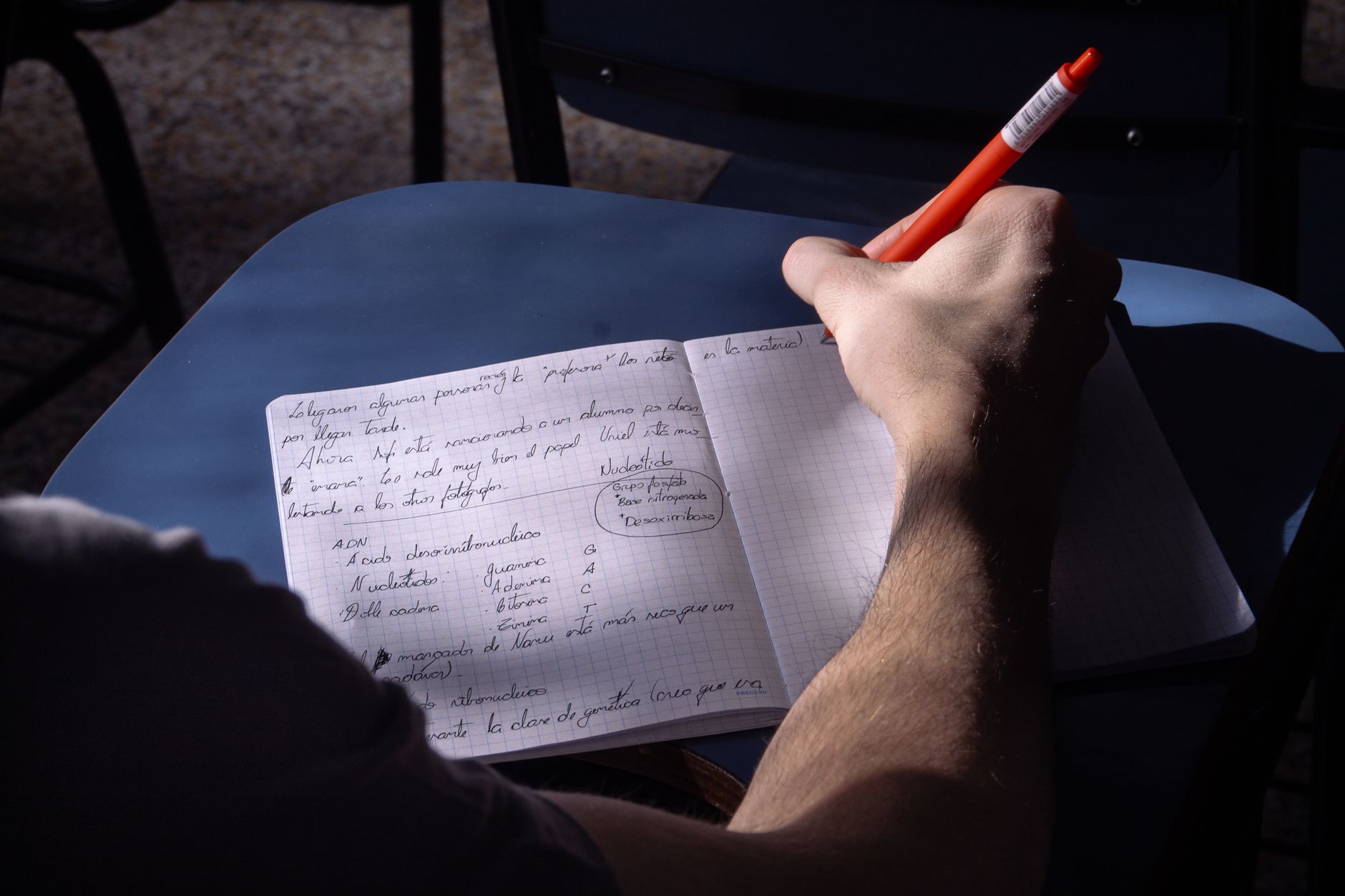
Photo by jessica olivella on Pexels
Capture is not the goal. Reuse is.
If you only change one thing about your note-taking, change this: do not optimize for capturing more. Optimize for the notes you will actually return to.
A page of dense transcription that you never re-read is worth less than three lines you revisit four times. A perfect color-coded outline that sits untouched is worth less than a messy page you used to quiz yourself the night before section.
Every note-taking method below is judged on the same criterion: does it set up retrieval, or does it just produce a record? Notes are the raw input. The study techniques that actually move grades (active recall, spacing, interleaving) are the engine that runs on top of them. Capture without reuse is a parked car.
1. The Cornell method (still the best general-purpose system)
The Cornell system is 70 years old, and it works because the structure forces reuse.
Divide each page into three sections:
Right column (about 6 inches wide): notes during the lecture.
Left column (about 2.5 inches wide): cues, questions, and keywords, written after the lecture.
Bottom section (about 2 inches tall): a 2-sentence summary, written within 24 hours.
Aim for 5 to 7 cues per page. Fewer and you have not actually processed the material; more and you are just copying headings.
Here is what a real Cornell page looks like for an American History since 1865 lecture on Reconstruction:
Right column: notes on the Black Codes, the Freedmen’s Bureau, the 14th Amendment debates, Andrew Johnson’s vetoes.
Left column cues: “Why did Johnson break with Radical Republicans?” / “What did the Black Codes do that slavery had done?” / “Which clause of the 14th Amendment ended up doing the most legal work?” / “Compare Lincoln’s plan to Johnson’s.” / “Why is 1877 the conventional end date?”
Bottom summary: “Reconstruction collapsed because federal will outran federal patience. The legal scaffolding survived in the 14th Amendment; the political project did not.”
The cue column is the part most students skip. It is also the most important part. Writing the questions whose answers are in your notes converts the page from a transcript into a self-quiz. Cover the right column, look at the cues, retrieve the answers from memory. That is active recall built into your note format.
This is why Cornell beats the more elaborate systems for most students: it is simple, fast, and the structure does the retrieval work for you.
2. The outline method (for hierarchical material)
The outline method is what most students default to without naming it. Bullets, sub-bullets, sub-sub-bullets. It works well when the material has a clear hierarchy: American History since 1865, intro biology, comparative politics, anything chaptered.
To do it well:
Stop one level shallower than feels natural. Three levels of indentation is usually enough. Most students go to four or five and bury the structure in detail.
Indentation is meaning. A sub-bullet should be a real component of the parent, not just a related thought.
Leave white space. A blank inch under each section. Tomorrow you will add a connection or a question. Without space, you will not.
Outlining is poor for material that is non-linear: a Lit Theory seminar on Derrida, a Diff Eq problem set with branching cases, a neuroscience lecture on receptor signaling. For those, use mapping.
Photo by Zen Chung on Pexels
3. Concept mapping (for systems and relationships)
For courses where the content is a web of relationships (neuroscience pathways, ecological systems, philosophical arguments, signaling cascades), a linear outline buries the structure that matters.
A concept map is a diagram. Nodes are concepts, arrows are relationships, labels on the arrows describe the relationship. It looks chaotic. The chaos is the point: the map matches the shape of the actual knowledge.
You do not need software. A page of unlined printer paper and a pen is faster than any app. Build the map as you go in lecture, redraw it cleaner that night (15 to 20 minutes), and use the redraw as a retrieval session. The redraw is the studying; if you have to look back at your notes more than twice while redrawing, you have found the soft spots in your understanding.
4. The charting method (for compare-and-contrast material)
When the course is comparison-heavy (different drug classes in pharmacology, four schools of literary criticism, the Reformation versus the Counter-Reformation), a table beats prose.
Columns for the things being compared, rows for the dimensions of comparison. This is what your professor is asking you to know, in the most efficient possible form for the exam.
Build the chart during the lecture if you can see the structure coming. Otherwise build it after, from your outline notes, as a synthesis exercise. A 5-column, 8-row table covering an entire unit fits on one page and becomes the single best review sheet you will own.
Photo by Roxanne Minnish on Pexels
5. The “questions in the margin” method (most underrated)
This is not a full note system. It is a habit to add to any of the above.
While taking notes, write a question in the margin every time you write something important. Not “what is X,” because that is too easy. Write the question the way you imagine it on the exam.
For example, if your Bio 200 professor explains the citric acid cycle, do not just outline it. In the margin, write: “Draw the citric acid cycle from memory and label the carbon counts at each step. Identify where CO2 leaves and where NADH is produced.” That question becomes a future quiz prompt you will actually use. If you want this habit to do real work in the long run, lean on a spaced repetition study method so the questions cycle back at 1, 3, and 7-day intervals instead of dying in the margin.
Most students never go back to their notes because the notes do not tell them what to do with them. Marginal questions fix that.
6. Handwriting vs typing
The honest answer is more nuanced than the popular take.
Handwriting is slower (around 20 words per minute versus 60+ typed), which forces synthesis. You cannot transcribe verbatim, so you summarize, which is itself studying.
Typing captures more, which can be useful for a dense Diff Eq lecture but often produces transcript-quality notes that are never reused.
Tablet (Apple Pencil, Surface) gets the synthesis benefit of handwriting and the searchability of typing.
The “handwriting is always better” research has been replicated weakly. The real variable is what you do with the notes afterward, not what tool you used. A typed note you review four times beats a handwritten note you never touch.
That said: in most courses, handwritten or tablet notes outperform laptop transcription, because the slower input forces selection. The one exception worth naming is a fast, dense lecture (a Diff Eq derivation, a literature lecture full of quotation) where missing the first half of a sentence costs you the second. There, type.
What to do in the 24 hours after a lecture
This is where most note systems fail. The notes are taken Tuesday at 10am and not touched again until the exam in five weeks.
Within 24 hours, spend 15 to 20 minutes per lecture on this:
Fill in the Cornell cue column or write 5 to 10 marginal questions on your outline.
Write a 2-sentence summary of the lecture’s main point. If you cannot summarize it in two sentences, you missed the thesis.
Flag what you did not understand. Star it. This is the highest-value piece for office hours or your study group.
Twenty minutes spent on this within a day of the lecture saves hours during finals week and dramatically improves long-term retention. It is the single highest-leverage note habit, and it only works if your week actually has the time for it, which is exactly what a study schedule maker protects with a daily 30-minute review block.
The trap of the “perfect notes” student
You know the one. Color-coded, custom Notion template, calligraphy headers, three highlighter shades for each professor. The TikTok aesthetic of studying.
It feels productive. It is mostly performance. The hours spent on the aesthetic are hours not spent on retrieval. The students who reliably pull As take messier, faster notes and spend the saved time on practice problems and self-quizzing. The rewriter who never reviews loses to the scribbler who does, every semester and in every course.
The other failure mode worth naming: the recorder. Students who lean on lecture recordings or auto-transcription and “deal with it later.” Later does not come. Two hours of audio you intended to re-listen to is two hours of nothing.
Notes are infrastructure. They should be functional and quick. Beauty is a side effect, not a goal. If beautiful notes correlated with good grades, every art student would have a 4.0.
How a planner connects notes to retrieval
The hardest part of using notes well is the discipline of returning to them on the right schedule. Three days later for the first review. A week later. Three weeks. The night before the exam. Doing this by hand for four or five courses is exhausting, and it is why most students stop by week four.
StudyEdge AI can ingest your notes and run the spaced retrieval schedule against them, surfacing the right material at the right interval so the notes you took actually get reused. The note-taking method matters less than what happens after you take them.
How to take better notes in college: take fewer of them, structure them for retrieval, return to them on a schedule. The aesthetic does not appear in the grade book. The reuse does.
Put the system to work
StudyEdge AI is the study planner that knows your courses, your grade weights, and your exam dates. Free to start.
 StudyEdge AI