Exam Anxiety Tips That Actually Work (Not Just Deep Breathing)
Exam anxiety tips grounded in cognitive behavioral research. Reframe the body's signals, build a pre-exam protocol, and stop the spiral before it costs you points.
 StudyEdge AI
 Exam anxiety tips grounded in cognitive behavioral research. Reframe the body's signals, build a pre-exam protocol, and stop the spiral before it costs you points.
StudyEdge AI The standard advice is some version of “take deep breaths, you got this.” It is not wrong. It is just useless at the moment you need it. By the time you are in the room with the Orgo II final in front of you and your heart at 110 bpm, a generic relaxation tip is not going to outpace the spiral.
Exam anxiety is a physiological and cognitive event with predictable mechanics. You can intervene on it the way you would intervene on any other system: at the inputs, at the moment of arousal, and at the thought patterns that escalate it. The tips below work because they treat anxiety as a process, not a feeling.

The fastest cognitive shift with the largest impact: your racing heart, sweaty palms, and tight chest are the same physiological state as excitement. The body does not have a separate signal for “I am threatened” versus “I am about to perform.” The brain decides which label to apply.
Alison Wood Brooks’ 2014 work at Harvard (“Get Excited”) tested this directly. Participants given high-stakes tasks (public speaking, math under pressure, karaoke) who said out loud “I am excited” outperformed those who said “I am calm” and those who said nothing. The effect held across all three task types. The mechanism: trying to force calm fights the body’s signal. Reframing as excitement aligns with it.
Your racing heart and sweaty palms are the same physiological state as excitement. The brain decides which label to apply, and the label you choose is the lever.
When you sit down for the exam and feel your pulse climb, name it: “I am excited. My body is getting ready to perform.” It sounds like a trick. It works because it shuts down the secondary anxiety (the anxiety about the anxiety), which is where most of the real damage lives.
A small amount of pre-exam nervousness is performance fuel. It sharpens attention and pulls you into the room. The problem is not the nerves. The problem is the spiral: the thoughts about the nerves that escalate them.
The spiral usually goes:
Interrupting at step 2 is the highest-leverage move you have. The signal of arousal is fine; it is the same one an athlete has at kickoff. The story you tell about it is what makes it disabling. “My heart is pounding, that means I am ready” lands you in a completely different exam than “my heart is pounding, I cannot do this.”
The “I’ll feel ready when I feel calm” fallacy belongs in this section too. You will not feel calm before a high-stakes exam. Waiting for calm before you start the test is waiting for something that is not coming. You start when the proctor says to start, anxious or not, and the anxiety drops on its own once you are working a question.
Anxiety eats decision-making capacity. The morning of an exam is the worst time to be deciding what to eat, when to leave, what to bring. Build a protocol the week before so you do not have to think.
A workable template:
The point is not these specific items. It is that you are running a routine, not making decisions while flooded. (The deeper version of this prep (covering how to do the actual studying that earns you the confidence underneath the protocol) lives in how to study for finals.)
“Take a deep breath” is wrong in a small but meaningful way. Big inhales activate the sympathetic nervous system, the one driving the racing heart. You are making the problem worse.
The right move is the long exhale. Breathe in normally through the nose for about 4 seconds, then breathe out slowly through pursed lips for 8 seconds. Six to eight cycles. This stimulates the vagus nerve and the parasympathetic response. Heart rate drops measurably within 60 to 90 seconds.
This works in the exam room, at the desk, before you flip the page. It does not require anyone to know you are doing it.
If you have catastrophic thoughts before exams (“I am going to fail Anatomy,” “I will not get into PA school,” “everyone will know I am the dumb one in this study group”), arguing with them in your head does not work. The arguments are happening in the same anxious brain that produced the thoughts.
Externalize them. The night before, write the worst-case story in full. Then, in writing, answer:
This is a standard CBT technique called cognitive defusion. The act of putting the catastrophic thought on paper next to the realistic counter-thought reduces its emotional weight. You are not denying it. You are giving it a smaller seat in the room.
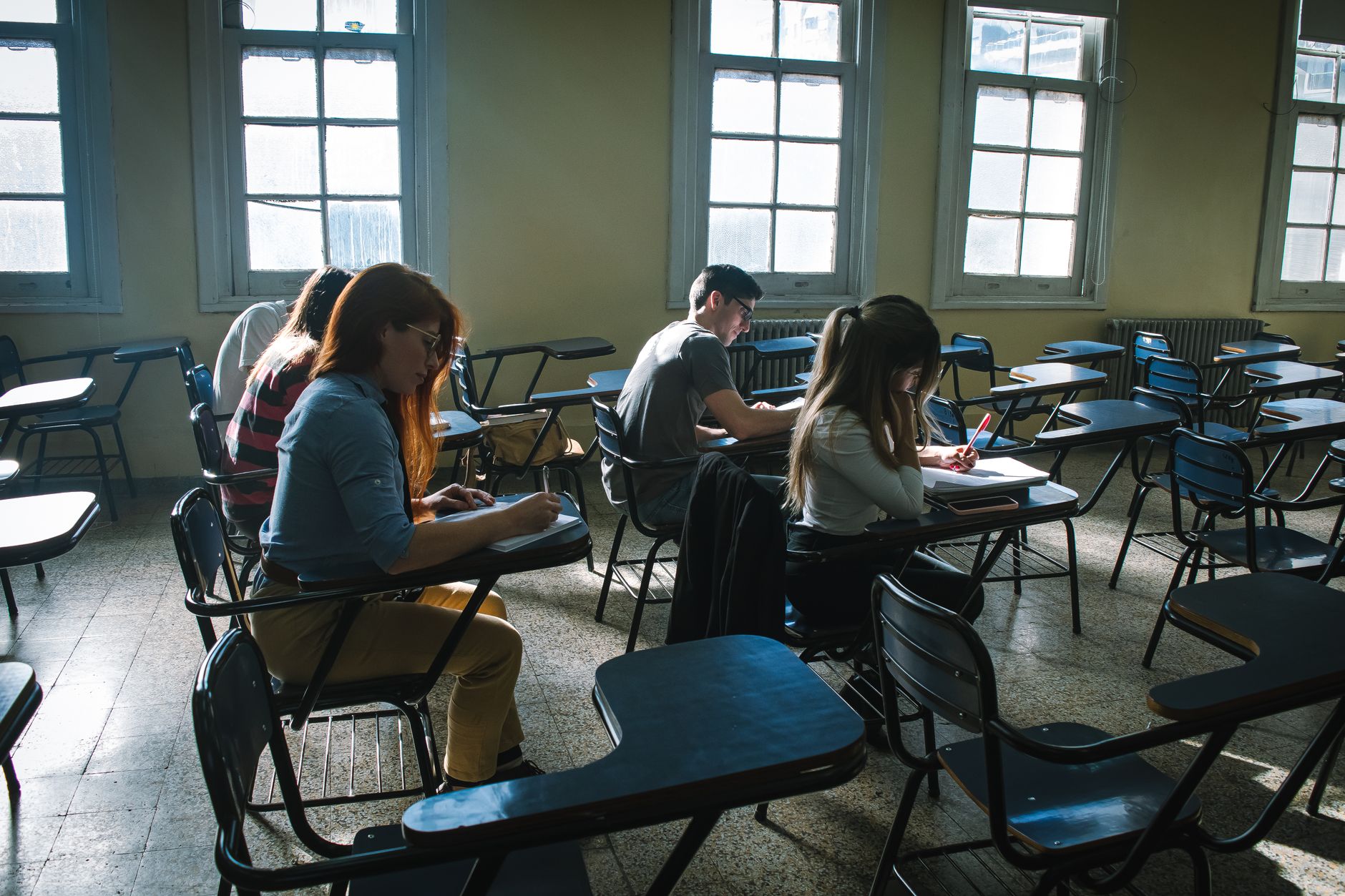
Test anxiety is partly a context mismatch. You practiced calmly at your desk with snacks and Spotify. The exam happens under time pressure, in a strange lecture hall, with people sniffing and pencils clicking and the proctor pacing. Your brain reads the mismatch as threat.
The fix is to make at least one practice session look like the real thing:
Two or three sessions like this before a high-stakes exam dramatically reduce surprise-induced anxiety, because the conditions are no longer novel. Closely related: if your study environment at baseline is chaotic and overstimulating, your nervous system never gets to settle in the first place. How to focus while studying covers building a study environment that is not constantly low-grade stressful.
When anxiety spikes mid-exam, the trap is to stare at the hard question, feel worse, and freeze. Ten minutes go by. Now the time pressure is real, which makes the freeze worse.
The move is:
The worst exams happen when one stuck question becomes the entire emotional event. Triage prevents that.
Comparing answers with classmates in the hallway is a near-universal trigger for post-exam anxiety. It does nothing useful. The exam is over. You cannot change it. The “I had B for number 14” spiral wrecks your sleep, eats your prep for the next exam, and improves nothing.
This matters even more during finals week, when there is another exam in 24 hours. Walk away. Eat something. Move on. The most productive thing you can do is restore cognition, not relitigate the last test.
If exam anxiety is consistently disabling (you are throwing up before tests, blanking on material you know cold, avoiding exams), this article is the floor, not the ceiling. The university counseling center exists, costs nothing for students at most schools, and CBT-trained therapists have specific protocols for test anxiety that work better than any self-help can. Use them.
Most exam anxiety has a hidden upstream cause: the well-founded suspicion that you have not actually done the work. Reframing and breathing can help at the margins, but no breathing technique compensates for walking in underprepared. When the prep is real and structured, the in-the-moment nerves are smaller and easier to handle.
StudyEdge AI builds the prep that prevents the spiral from being justified. Spaced retrieval across the term, an actual finals plan, and the visible record that you did the work. The most underrated exam anxiety tip is: walk in knowing you prepared.
Exam anxiety is manageable. The tools are real. Train them before you need them, and they will be there when the room goes quiet.
StudyEdge AI is the study planner that knows your courses, your grade weights, and your exam dates. Free to start.
Try StudyEdge AI FreeFree to start. No credit card required.
How to study for finals without the all-nighter spiral. A real 7-day plan: triage by risk, build session blueprints, run active recall, and walk in calm on exam day.
How to focus while studying without relying on willpower. Environment design, attention residue, the two-minute rule, and the routines that produce real deep work.